
A dollar sitting still today buys less than it did a decade ago — quietly, every year, whether you notice or not. This isn’t a sales pitch. It’s the math behind why “saving” isn’t the same as “keeping up.”
Most people track their income closely and their purchasing power not at all. This page walks through the difference, using ordinary prices and a plain-language guide you can actually use — no jargon, no pressure, no one calling you afterward.

No jargon, no sales call, no “expert broker” reaching out. Just a short PDF that walks through how purchasing power is calculated, where the official numbers actually come from, and a simple worksheet so you can run your own figures against your own budget.
It takes about ten minutes to read and maybe twenty to work through the worksheet. There’s no upsell at the end — just the numbers, explained clearly enough that you could show them to someone else.
EXPLORE TRADING OPPORTUNITIES TODAY
Prices don’t move in a straight line, but the direction rarely reverses. Here’s a rough sketch of one everyday item over the last decade — the kind of number that doesn’t show up on a bank statement, but adds up in a grocery bill.
None of these numbers are dramatic on their own. That’s exactly the point — inflation rarely announces itself. It shows up as a slightly higher total at checkout, a slightly smaller grocery bag for the same amount of money, a raise that somehow doesn’t feel like one.
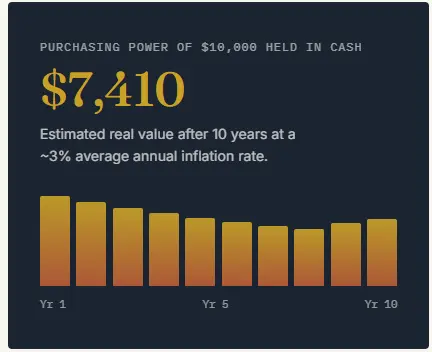
If you had £100,000 sitting in the bank back then, it would only buy about £80,000 worth of goods today — that’s a 20% loss in real value due to inflation.
Now, while bank savings accounts paid less than 1% interest per year, inflation averaged around 2.5–3%, meaning your money was silently losing value year after year.
But here’s the real kicker — during that same decade, the Nasdaq 100 index grew by almost 400%.
In other words, money invested in the market didn’t just hold its value — it multiplied nearly five times.
And while most people trusted their banks to ‘keep their money safe’, the banks and professional traders were using that very same money to make those returns for themselves.
So while your money sleeps, someone else is making it work — for them.
It’s time to take control and make your money work for you instead.
Purchasing power isn’t an abstract economics term. It shows up directly in ordinary choices about where money sits and what it’s expected to do.
It is an online trading app especially built to help you invest in Gas and energy-related financial assets. It uses automated tools and algorithms to assess market trends and assist users in making trading decisions.
Yes, Gas Errtrag is a beginner-friendly trading app that thta comes with a simple interface and educational content. This helps beginners to learn how to make wiser trading decisions. Its features are designed to help new users understand trading concepts and enhance their confidence in financial markets.
The platform allows access to a wide variety of financial assets. Users can trade commodities, precious metals, and stocks. This variety helps users to diversify their investments in various sectors. They can explore numerous trading opportunities with the help of this versatile investment app.
The platform uses strong security protocols and protects user data. However, it still needs to be used with caution. The digital financial sector always includes risks, so users are always advised to be responsible for the trading decisions they make.
No, Gasertrag does not guarantee profits. The platform clearly states that all trading activities involve substantial risk, and users may lose their investment. It advises users to trade responsibly and only invest money they can afford to lose.